
Adding Sewing Instructions to a Knit or Crochet Pattern
In this series we do a deep dive into items I check for in every pattern I edit, the most common issues I see, and how to correct for them.
Although I consider myself an advanced beginner sewist overall, I’ve known the basics of sewing for longer than I’ve known the basics of knitting – having two grandmothers and a mother who sewed and growing up as a dancer with a lot of pointe shoe ribbons and recital costume straps to adjust has given me a pretty solid foundation on basic sewing skills. Which means I’m always excited to be asked to edit a knitting pattern that includes some sewing – usually that’s inserting a fabric lining into a bag, but it can include adding non-yarn embellishments on a toy or garment, or a special fastener (I’ve done a few patterns involving putting magnet closures inside a fabric pouch then attaching that to the knitting).
When a pattern comes across my desk that requires sewing fabric or trim, I know there are extra elements in the pattern that will need to be checked. If you’re designing (or have designed) a pattern like this, here are some things to keep in mind:
Give potential makers a heads up BEFORE they purchase. Always clearly describe what sewing materials are needed AND what sewing skills are required on the purchasing info page for the pattern. Even if the sewing in your pattern is beginner level, not everyone has needles, thread, or fabric scraps handy so it’s good to let potential makers know if they’ll need to get additional supplies. This goes double if you are going to recommend sewing with a machine!
Use general sewing terms or provide definitions of any techniques. If you want non-sewists to feel comfortable trying your pattern, avoid using technical sewing terms like seam allowance or naming certain types of stitches (backstitch, hem stitch, etc.) unless you are willing to define them in the pattern (or link to tutorials).
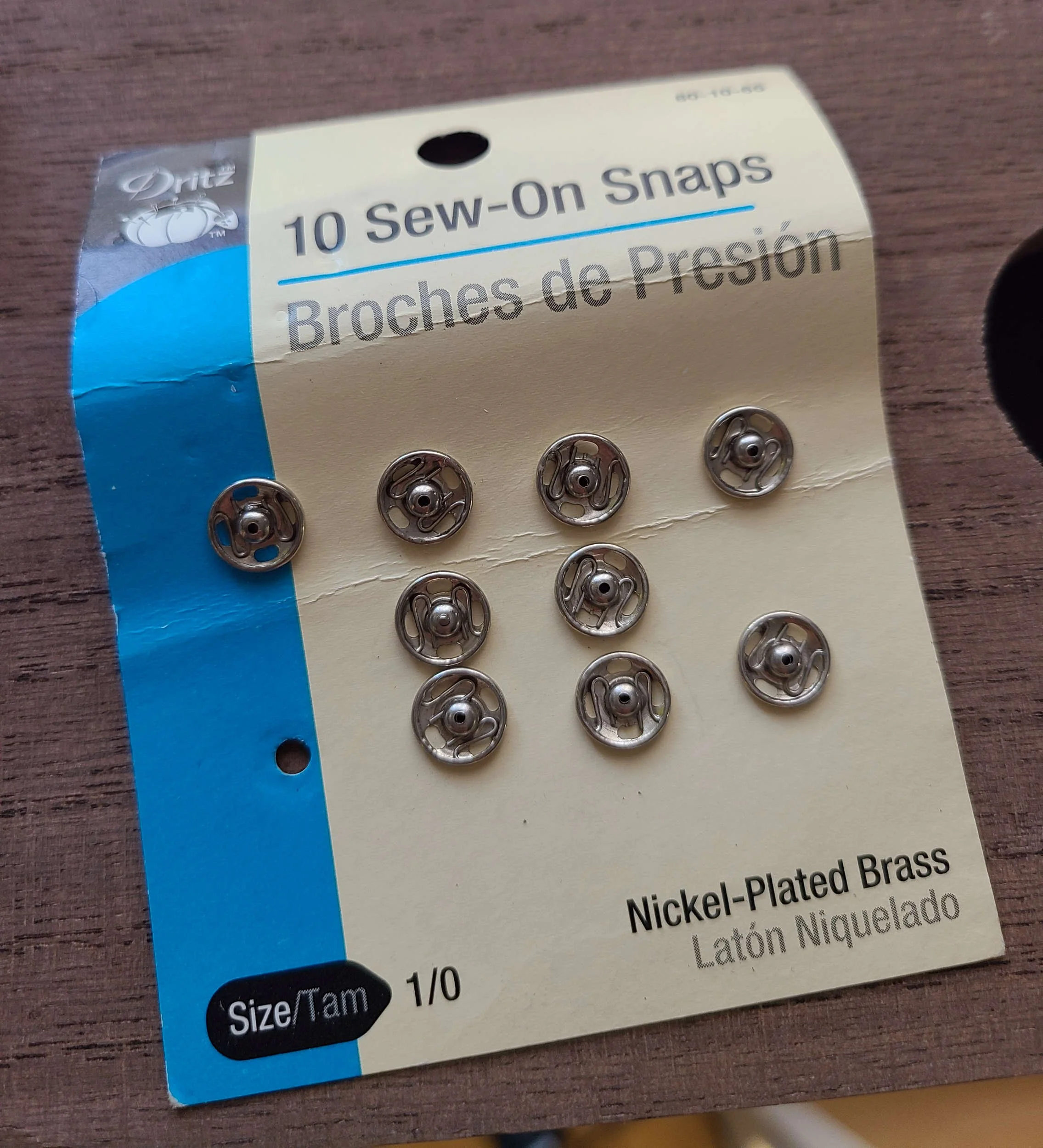
If you want your pattern to be accessible to an international audience, check that you are using terms for notions that will be broadly understandable. “Zip” (UK) instead of “zipper” (US) is not difficult to understand, but I recently learned that a common term for a snap in the UK is “press stud,” which is not a common term in the US - in fact I initially thought it meant a grommet, not a snap!
Proofreading your notions list is extra important. Double check that the amount of fabric, length of trim or zipper, or the number of fasteners called for in the pattern are truly the amount you need. If there are buttons, the size called for should fit the buttonhole in the pattern.
I’ve edited patterns where the buttons listed had the wrong unit of measurement (a 5 cm button and a 5 mm button are vastly different sizes!) and where a conversion error resulted in asking for 4 feet of ribbon for a tie around a knitted doll’s neck (the designer’s original measurement was 20 cm, they accidentally multiplied rather than divided when converting and got 48 inches instead of the correct 8 inches).
If the pattern will use small amounts of fabric or trim it can be helpful to list both the exact amount needed and the smallest measurement that can be bought pre-cut (a fat quarter, a half yard, etc.) so people can determine if they have scraps big enough or need to buy something. Also make sure if a certain notion comes in different varieties that you specify the best one. For example, if you want people to make French knots to embellish a pattern, you’d want to specify “embroidery thread” rather than just “sewing thread.”
Check with a sewist. Ask a friend (or tech editor) with sewing experience to read through your making up instructions. Sometimes when you’re thinking about assembly from a knitting/crochet perspective it’s easy to forget some of the extra steps fabric sewing requires – particularly when it comes to hems and finished edges.
I recently edited a small knit bag that had both a fabric lining and a zipper sewn in. Securing the zipper’s edges behind the lining while also adding the fabric lining and closing the knit square that made up the bag required a very specific order of steps. In the original pattern draft, the knitted sides were closed first, which matched instructions for a smaller bag in the pattern that didn’t have the zipper. In their desire to make the finishing instructions as short as possible, the designer had inadvertently made attaching the zipper much more complicated.
I suggested a change to leave the knitted sides open until the end, which allowed a maker to easily turn the bag inside out, pin and sew the zipper in, and then turn it right side out before fully closing the sides. It did make the finishing instructions a bit longer since the larger bag had to be done in a different order, but the sewing technique needed was much simpler.
Model the assembly while writing. When pieces need to be folded or seamed, one of my go-to methods for checking the assembly instructions is to use pieces of paper to represent the different layers (one paper labeled “knitting RS” and “knitting WS”, one labeled “fabric RS” and “fabric WS”, for example). This allows me to follow the folding or seaming instructions and make sure the correct side of each piece winds up in the right place. This technique once helped me spot an error in the assembly instructions for a lined bag that had a layer of quilt batting between the knit outer shell and the fabric lining – the instructions as written would have resulted in the quilt batting being the innermost layer (the layer you would have seen when opening the bag), when it needed to be the middle layer, between the fabric and the knitting. But juggling my three sheets of paper, it was quickly clear that a couple of edits were needed to get things in the correct order.
If you’re a designer, you may have finished the original sample for your pattern some time before writing up the pattern. Using paper to model the assembly as you write can help you decipher any unclear parts of your notes and ensure that the instructions you write will result in the finished object you designed.
Combining sewing techniques with knit or crochet can result in extra special finished objects, but it’s important to check your sewing instructions just as carefully as you would the knit or crochet part of the pattern. If you’re planning to design a pattern with sewn elements, hopefully the above tips will help you create a pattern that’s clear for both sewists and non-sewists to understand!


I’m Whitney, a tech editor, graphic designer, and lifelong crafter. Join me for an exploration of my latest knitting, crochet, sewing, and upcycling projects, tips on knitting technique, editing tips for knitting designers, and more!